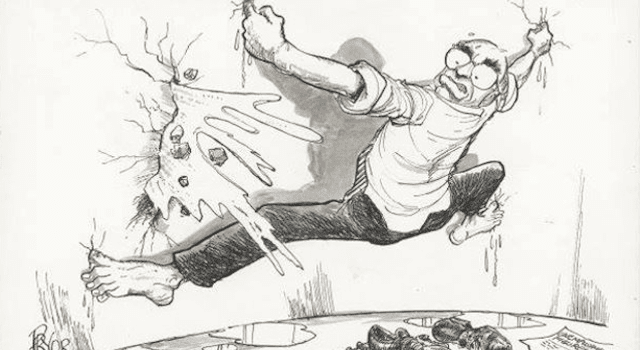
There have been two constants across my Rotary journey, which began as a Rotaractor in 1986: disturbing membership decline and pathological resistance to change. To suggest they are not interrelated would be delusional. This resistance to change became immediately evident to me as a Rotaractor in the early 90s. Rotaract was always an organisation with both males and females; that was part of the allure! At the time I joined Rotaract, I really didn’t know too much about Rotary. I was 18 and didn’t really know too much about anything. I certainly didn’t know the organisation was staring down the single biggest change in its (then) 81 year history: the introduction of women. Whilst I could not possibly imagine a Rotaract without women, it soon became apparent that there were plenty of Rotarians who couldn’t imagine a Rotary with them.
Club autonomy has always been important in Rotary, and every club had to vote independently on whether they would accept women into membership. At the time I was in the Rotaract Club of Edwardstown, which was sponsored by the Rotary Club of Edwardstown. It took that club a few attempts to get the naysayers over the line, but they eventually got there. Some members resigned over it. 30 years later and there would not be one member of that club who could possibly regret that decision. I would suggest their only regret was that it took them so long. But some clubs took much, much longer to make that decision. It’s incomprehensible to me that some clubs have steadfastly remained all male to this day, a day in which our RI President is female (finally).
Clubs across Zone 8 will have another important decision to make in a few months’ time. They will be voting on whether Zone 8 participates in a regionalisation pilot. But there’s a major difference in the wider ramifications of this vote. Unlike the vote to accept women into membership, where the clubs that voted to reject female membership didn’t impinge on other clubs’ capacity to accept female membership; any “NO” votes (or abstentions, which will count as a “NO”) to the regionalisation pilot will have a flow on effect right across the zone. All districts across Zone 8 require a two thirds majority of clubs voting “YES” for the pilot to proceed. To clarify, if just one district across the zone has 34% or more clubs voting “NO” to this proposal, the opportunity to run our zone in a way that best suits our region and its many cultures will pass on to another zone. And there are plenty of zones lining up to jump at this chance if we let it slip through our fingers.
I’ll go into what’s at stake in more detail later, but first I will analyse our recent history of membership decline and its coupling with resistance to change. There is no doubt in my mind that the admission of women into Rotary in the early 90s was the biggest ever rule change from a membership perspective. Most (not all) of the organisation eventually came to its senses and decided that excluding half of our membership market was counterproductive. I am about to detail several changes implemented since then, all of which were designed to either directly or indirectly help Rotary reach new markets and strengthen its membership; and as you will see, every single one of them without exception faced opposition.

The world’s first Eclub was chartered in 2001, ushering in a very new style of club which catered for a less geographic demographic. These clubs would cater for the nomadic, the FIFO, the shift worker, the isolated volunteers, or those who would otherwise struggle to attend regular meetings but wanted to contribute. But at the time there was still a strong feeling that the primary mission of a “good Rotarian” was regular meeting attendance. Because Eclub members weren’t physically turning up at a pub every week to order a chicken dinner, hand over their hard earned to a sergeant and listen to a guest speaker, they weren’t considered “true Rotarians” by many. It’s a mindset that still exists today.
.jpg) |
| This is not photoshopped! |
A few years later there was a strong push to prioritise member engagement over member attendance. This was something that immediately resonated with me at the time. The concept of a “service” club which prioritised meeting attendance over service has always sat uncomfortably with me. Every member had to achieve a certain percentage of meeting attendance. It mattered not how productive the meeting was, we just had to be there. And if we couldn’t be there, we were to do a “make up” by attending another club meeting.
It was around this time that “flexibility” became a bit of a buzz word in Rotary circles. It was well understood that our rigid structures were affecting our ability to grow our membership. The cost of membership, and those 50 odd chicken dinners and sergeant sessions was clearly becoming a barrier too. Those attendance rules were relaxed at the end of the decade, I can’t remember exactly how, but I think it was primarily a lowering of the expected meeting attendance percentage. And guess what? The traditionalists complained about that too.
The 2013 Council on Legislation (COL) allowed for project work to count for attendance, i.e. it enabled Rotarians to use participation in a service project to count as a make up, to keep the attendance wolves from your door. Just imagine the aliens landed and we had to explain to them that in our service club our prime objective was attending meetings, and only if we exhausted all other options to attend meetings, could our sins be absolved by contributing time to make an impact in our community. They’d surely be questioning if there was intelligent life on Earth. But this was the Rotary way for close to 100 years.
From 2007 – 2013 RI offered a pilot program to a number of clubs across the world which allowed them to experiment with their meeting frequency. Another pilot program ran between 2011 and 2014 where 500 clubs were selected to trial associate and corporate membership, satellite clubs and other innovative and flexible options, all of which did not fit within the rule book of the time. These programs were oversubscribed. Thousands of clubs applied, but missed out on the opportunity.
The resulting feedback from those trials led to major changes being introduced at the 2016 COL. Corporate membership models were initiated, the requirement to meet weekly was removed and other meeting flexibility measures were introduced. New club models were introduced, including satellite clubs, passport clubs and hybrid clubs. I personally think the removal of the weekly meeting requirement had the opportunity to be a game changer.
So, how do you think these measures were greeted by the Guardians of the Status Quo? In the subsequent (2019) COL, proposals made it to the floor to wind back those massive changes of 2016. Fortunately, none of them got up.
 |
| The superseded pre-2013 logo (L) and the current logo (R) |
In 2013 RI introduced new branding. 9 years later, that branding is still being rejected for largely nonsensical reasons. Many proponents of the old logo are ignorant of the process that led to this change. The 2013 branding update was introduced in response to the findings of a landmark review commissioned by RI into our branding and strategy.
Global strategy, design and experience firm Siegel + Gale conducted a survey of Rotarians and stakeholders from 17 countries, and reported their research findings to the RI Board in 2012. The presentation to the board is documented in Revitalizing Rotary, where amongst other things, it identified that Rotary had an identity crisis. But many are still contributing to that crisis, some wilfully.

I am currently part of a team of District 9510 presenters rolling out a presentation to every club in our district on the importance of this rare opportunity. Every club across the zone has been given the opportunity to see this presentation and ask questions. In my own district, it looks like every club will see it, and I hope that’s the case across the rest of the zone.
This is not the place to go over the entire presentation. If you’re in Zone 8 you will all get a chance to see it if you haven’t already. But I do want to illuminate a few aspects of this pilot that I see as important. And let’s be very clear with the definition of “pilot”. It’s an opportunity to experiment and trial new ways of doing things. If we do get the approval to enter this pilot, we hope to find ways to improve opportunities and support for our members and clubs, to better communicate our message on a wider scale and to lower member fees. Anything we discover will not just automatically be adopted. There will be considerable consultation across the zone on what gets implemented and what does not. But we won’t have the chance to discover anything if enough clubs vote “NO”.
Speaking with one voice.
Trying to deliver a consistent message across our country or zone is akin to herding cats under the current system. Every district has to agree to the content and delivery of broad scale campaigns, and that agreement is not always easy to get. District boundaries are pretty arbitrary. Apart from Tasmania, which is currently a one district state, the lines that separate our districts have very little geographic meaning and form anything but natural markets. They cross state and country borders in a method that theoretically encapsulates a quantity of Rotarians to make administration easier for RI Headquarters. Over many years of re-districting, borders have shifted and entire districts have been subsumed. District 9830 (all of Tasmania) has 47 clubs across an area of 68,000 km2. My district (9510) includes most of (but not all of) South Australia plus parts of the Northern Territory, New South Wales, Victoria, and even a part of Queensland where there are no clubs. This is an area of about 1.5 million km2 with 82 clubs. Why do I mention this? If Rotary leaders in Tasmania wanted to run a state wide marketing campaign, it would be much easier to organise than my district, which zig zags across state borders and intersects advertising markets.
Past RI Director Stuart Heal recently commented (I will paraphrase) that if the head of Toyota wanted to strike up a marketing deal with Rotary across our zone, they would have to deal with over 20 districts. It would be much easier to speak with one person.
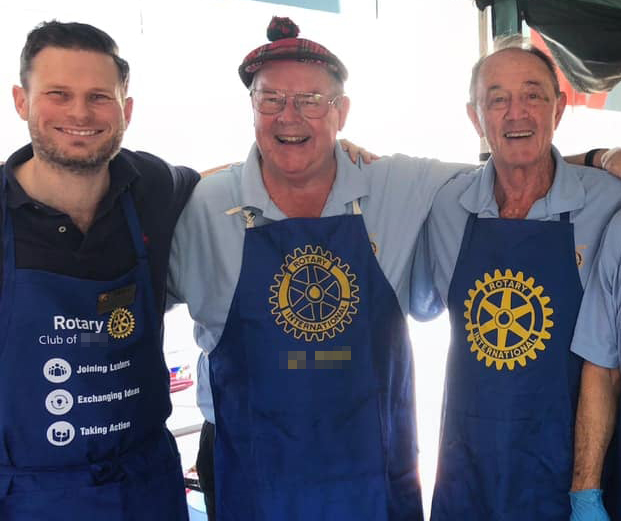 |
| Inconsistent branding at a club BBQ. |
Meanwhile, we can’t even get all clubs to update their branding to reflect a global change introduced nine years ago. Even within clubs, branding is often remarkably inconsistent. Regionalisation could address this.
Quality and Consistency of Member Training and Development.
I have been fortunate to have been given a unique and rare perspective on member training across the zone. I have presented on membership at PETS, District Assemblies, Conferences, and dedicated Membership Seminars in almost every district of Australia, and both islands of New Zealand. I’ve met some truly remarkable people and have experienced a broad depth of pedagogy in this field. Some of what I have seen has blown my mind. But some has been somewhat underwhelming. The average Rotarian might attend a District Assembly or PETS run in their district 2 or 3 times over their Rotary journey, and would not have any consideration for the training taking place across the rest of the zone. But for some of us who have seen a lot of it, you begin to question the consistency. I believe every district and RI fee paying Rotarian across the zone deserves the same access to best practice training, and right now, it’s a bit of a lottery depending on where you are. Regionalisation could address this.
Membership Development.
Similarly, the members of District 9640 (Gold Coast and surrounds) have experienced unprecedented club and membership growth over recent years. Why is this district so far ahead of the pack, when most districts decline in numbers year on year, forcing the re-districting which has and will continue to happen? Because there are some extremely passionate, talented, and visionary individuals when it comes to the science of marketing and membership development, but they are not evenly distributed and accessible across the zone. Regionalisation could address this.
There are many other resources that are not consistent or universally available to every member in every club across the zone, especially those clubs in remote locations. Some districts do youth exchange really well (COVID ramifications notwithstanding). Some have amazing vocational programs. Some run much better conferences. Some have extraordinary public image campaigns. Some have modest levies; some are much higher.
Keeping costs down.
For those who doubt that regionalisation can drop member fees, understand that districts have already been returning unspent funds to RI and members. Some of this underspending is due to COVID related travel and accommodation expense decline. Regionalisation will look at how District Governors Elect are trained too. A respected RI staffer recently reported that 85% of RI expenditure is directed to current District Governor costs and training their successors. Surely it's worth exploring if there are more efficient ways to govern our organisation, and if our current district structure is fit for purpose. There must be savings available from the removal of duplication across the zone.
Resistance.

I recently had a brief chat with a good friend of mine who happens to be a Past District Governor. His comment was that he hadn’t seen enough detail, so he’d be inclined to vote “NO”. It was immediately obvious to me that he hadn’t seen enough detail, because individuals aren’t voting on this; clubs are. And it’s one vote per club, no matter what size the club is. I guess there’s a “better the devil you know” mindset we have to overcome. I can empathise with the “not enough information” mindset, because the rollout of that information has only just started. The architects of this pilot have been caught between a rock and a hard place. If they had prepared a comprehensive outline of what the pilot would deliver, our members would have every right to condemn the lack of rank-and-file consultation. But by putting forward a skeleton with such little meat on the bone, the concerns are in relation to a lack of information. But considerable information is available for those who want to see it.
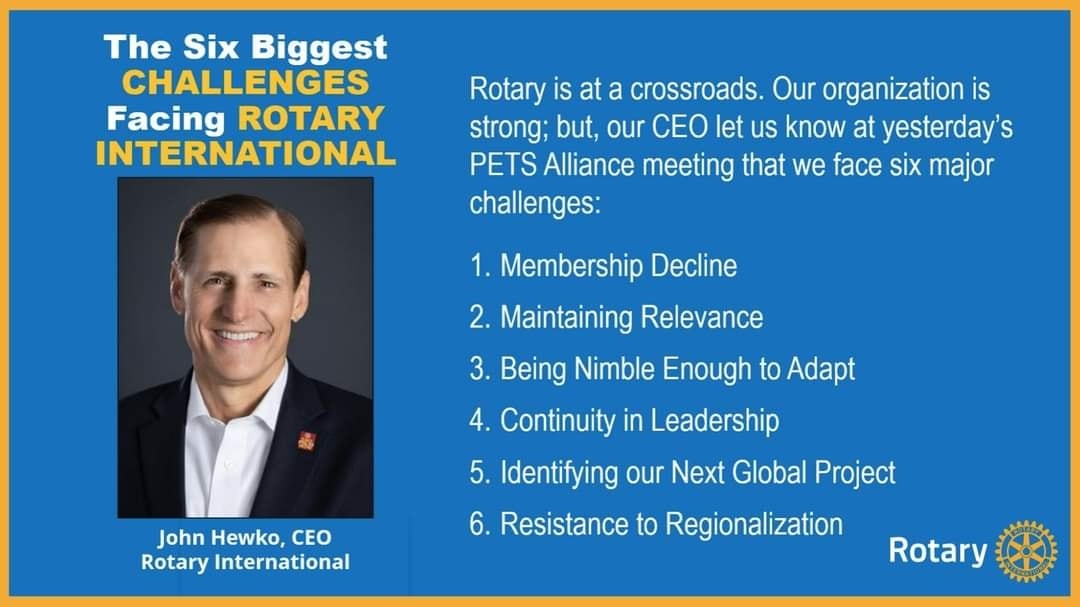
Rotary CEO John Hewko recently identified the six biggest challenges facing Rotary International, and one of them is “Resistance to Regionalization”. This pilot has been awarded to only two zones, one encompasses Britain and Ireland, assumedly because they already have a regional leadership structure in place, and the other is here in Zone 8 because so much work had already been done over the last few years on a similar plan. Make no mistake. If we pass up this opportunity, there will be many other zones wanting to take it on. RI Leadership are heavily invested in these pilots, and the RI Board of directors are dead keen for this to get up and learn what they can from the process. If our example can uncover a better model, it could spread across the globe. If another zone makes a good fist of it, we could soon be moving to the beat of their drum rather than our own.
A common question asked of the presentation team during their club visits, is "How exactly will the regionalisation pilot address our membership decline?" We need to understand that membership decline is not the illness, but a symptom of the illness. Some medical interventions address symptoms only, but some address the illness itself, which in my mind is predominantly about declining relevance and attractiveness to the volunteer market. If we can build and consistently convey our narrative, create new, attractive, inclusive and impactful clubs that people will want to join, lower the cost structure and better train and develop our members, I believe we can again make Rotary relevant to the public. The membership spoils will follow. But the question I would ask relates to that other aforementioned constant, "How exactly can we move beyond our historical resistance to change?"

In addition to the information campaign currently under way, I am calling on the army of progressive changemakers within the zone to rally the troops and do whatever you can to foster a “YES” mentality in your club. I've mentioned apathy, and I've mentioned resistance. But there is also outright opposition to this pilot from certain quarters. I would encourage you all, in the face of such opposition to question the motives of those opposers, and maybe ask them to elucidate their superior plan to reverse our membership crisis. If there is one, I'd be keen to hear it.
Please take the time to visit the Creating Rotary Tomorrow website, where you'll find everything you need to know about the Regionalisation Pilot. Let’s not look this gift horse in the mouth. In the end, we only regret the chances we didn't take.